

The point.
- The SFDR article number on a factsheet, 6, 8 or 9, is a disclosure rule. None of the three tells a fund what it may or may not buy.
- A fund's name binds harder than its article number. ESMA's naming guidelines attach an 80% threshold and a ban list to the kind of word a fund uses, and both ESG and SRI count as environmental words.
- Best in class screening ranks companies inside their own sector and keeps the leaders. Energy is a sector, which is why an ESG fund still holds oil companies by design.
- The number that separates two similarly labelled funds sits in the index rulebook, not on the factsheet. MSCI SRI targets 25% of each sector's free-float-adjusted market capitalisation; MSCI Selection targets 50%.
- On ESMA's 2023 UCITS cost data, funds filing under neither Article 8 nor Article 9 could not be told apart on ongoing cost from Article 8 funds. Structure, meaning ETFs and passive funds against active ones, drove a far larger cost gap than the label did.
The point.
- The SFDR article number on a factsheet, 6, 8 or 9, is a disclosure rule. None of the three tells a fund what it may or may not buy.
- A fund's name binds harder than its article number. ESMA's naming guidelines attach an 80% threshold and a ban list to the kind of word a fund uses, and both ESG and SRI count as environmental words.
- Best in class screening ranks companies inside their own sector and keeps the leaders. Energy is a sector, which is why an ESG fund still holds oil companies by design.
- The number that separates two similarly labelled funds sits in the index rulebook, not on the factsheet. MSCI SRI targets 25% of each sector's free-float-adjusted market capitalisation; MSCI Selection targets 50%.
- On ESMA's 2023 UCITS cost data, funds filing under neither Article 8 nor Article 9 could not be told apart on ongoing cost from Article 8 funds. Structure, meaning ETFs and passive funds against active ones, drove a far larger cost gap than the label did.
Your fund’s factsheet has a number on it. Article 6, Article 8, or Article 9. It sits near the word “sustainability” and nothing on the page explains it. The search that brought you here was probably some version of why does my ESG ETF hold oil.
Fair question. The oil is in there. On purpose.
ESG investing means using environmental, social and governance data to decide what goes into a fund. In the EU it reaches you as a label: an SFDR article number on the factsheet, plus a word in the fund’s name. Two sets of rules, and only one of them touches what the fund holds.
What ESG means in investing, for anyone holding a European UCITS fund, is a set of rules. A few say what the fund may hold. Most say what the manager must tell you. The rest of this piece is the gap between them.
What is ESG investing, and what does it change about what you own?
E, S and G are three buckets of data about a company that never reach its balance sheet. Environmental covers emissions, resource use, and waste. Social covers workers, suppliers, customers, communities. Governance covers who owns the firm and who runs it.
Most explainers online agree on that bit, so we won’t linger. What they skip is that two very different questions live inside those three letters. EU law keeps them apart.
The first: is this company at risk from environmental and social conditions? SFDR (opens in new tab), the EU’s rules on what a fund must tell you, calls that a sustainability risk. It defines it as an event or condition that could cause “an actual or a potential material negative impact on the value of the investment”. Risk to your money.
The second: does this company do harm? SFDR handles that separately, through principal adverse impacts: what a fund’s choices do to the world outside. A firm has to publish a statement on those effects, or publish clear reasons why it doesn’t.
One question is about the world’s effect on the company. The other is about the company’s effect on the world. A fund, a rating, or a marketing page can answer either, both, or neither. It won’t volunteer which one you’re holding.
Since 2 July 2026 a rating at least has to say. That’s the day Regulation (EU) 2024/3005 (opens in new tab), the EU’s rules on ESG rating firms, started to apply. ESMA, the EU’s markets regulator, confirmed the date in a public statement on 1 July 2026 (opens in new tab).
A rating firm now has to say what it measures: money risk to the company, the company’s impact on the world, both, or something else. Where it covers only one of those, it has to say so. And it has to show its working, because rating firms have long disagreed about the same company.
That regime is new, though, and the transition is still running. Firms already rating in the EU had to tell ESMA by 2 August 2026 that they intend to apply, and have until 2 November 2026 to file the application itself. Smaller providers have until 2 November 2026 just to notify. So an ESG rating quoted in fund marketing can still come from a firm ESMA hasn’t finished checking, and ESMA has said third parties may keep publishing those ratings until it decides. ESMA publishes the list of firms that have notified it (opens in new tab), and updates it as more arrive.
What do SFDR Article 6, 8 and 9 mean on a European fund factsheet?
All three are paperwork rules. They set out what the manager must write down, and then they stop. None of the three tells a fund what it may or may not buy. That last one is the point most people get wrong.
| On the factsheet | What triggers it | What the manager must write down | What it doesn’t cover |
|---|---|---|---|
| Article 6 | Every fund | How sustainability risks feed into the fund’s choices, or a clear account of why they don’t matter here | What the fund holds. A 6 doesn’t mean the manager ignored ESG |
| Article 8 | The product promotes environmental or social characteristics | How those characteristics are met, and, where an index is designated, whether that index fits them | No minimum proportion, no exclusion list and no composition test appear in the Article |
| Article 9 | The product has sustainable investment as its objective | How the objective is met, and how any designated index differs from a broad market one | The underlying definition of “sustainable investment” leaves managers wide discretion |
Article 8 is where most European funds with an ESG angle sit. Read the text and what stands out is the absence. No minimum share. No ban list. And no test of what the fund holds. A fund triggers Article 8 by promoting those features, and owes a written account of how it does so.
Article 6 catches everything, so a 6 can look like a low score next to a 9. It’s a baseline. A fund with no ESG angle files under Article 6. So does a fund whose manager thought hard about climate risk and chose not to advertise it.
The European Commission thinks the setup needs work. On 20 November 2025 it published a proposal to amend SFDR (opens in new tab), COM(2025) 841 final (opens in new tab). It is still a proposal, still on its way through the EU’s law-making process, and the fund groups it sketches bind nobody. Article 6, 8 and 9 are what’s on your factsheet today.
One note on geography, so its absence doesn’t read as an oversight. These are EU-level rules. They land the same way on a UCITS fund in Germany, Spain, Italy, Ireland and everywhere else in the bloc, so the article number doesn’t shift by country. The UK runs its own regime, which is a piece for another day.
Why does an ESG fund still hold oil companies?
Because of how the screen is built. The common design ranks companies against others in their own sector and keeps the ones at the top. Each sector survives that cut, energy included. Nobody slipped up. The oil is there by design.
What is the difference between exclusionary screening and best in class?
Screening out removes whole categories. Tobacco, controversial weapons, thermal coal: the rule says no, and the sector leaves your portfolio.
The other approach the industry calls best in class. It ranks companies against their own industry peers and keeps the ones clearing a hurdle, sector by sector. Three bodies agreed that wording between them: CFA Institute, the Global Sustainable Investment Alliance and the Principles for Responsible Investment (opens in new tab). They describe it as picking companies that overcome a defined ranking hurdle “within each sector or industry”, on criteria desirable “relative to peers”.
Read that twice. It’s the whole answer. A screen of that shape keeps the leaders in each sector. Energy is a sector. So the fund holds the energy names that scored best against other energy names, and it holds them by design.
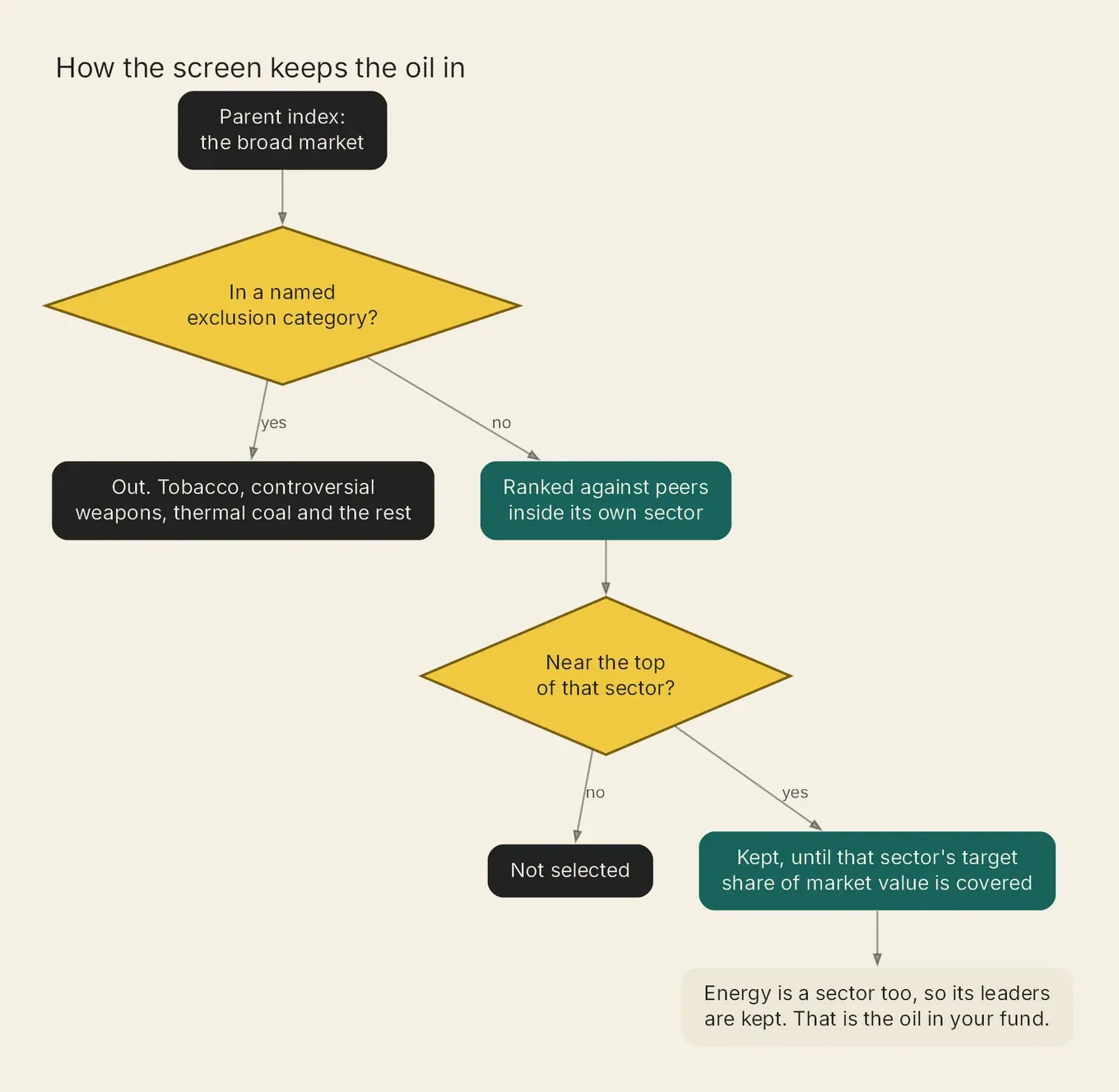
Someone made a design choice, and no one printed it on the front page.
Which number tells two ESG funds apart?
How much a screen removes isn’t on your factsheet. It lives in the index rulebook, a separate document put out by the index company. No one tells you it exists.
Here are two index families from one firm, MSCI, built on the same parent indexes, both sold to European investors under the letters ESG.
| MSCI SRI (opens in new tab) | MSCI Selection (opens in new tab), called MSCI ESG Leaders until February 2025 | |
|---|---|---|
| Share of each sector it targets | 25% of that sector’s free-float-adjusted market capitalisation | 50% of that sector’s free-float-adjusted market capitalisation |
| Minimum MSCI ESG rating to join | A | BB |
| Minimum controversies score to join | 4 | 3 |
| Same floors for companies already inside | BB and 1 | BB and 1 |
| Named exclusion categories | 16 | 12 |
Figures from MSCI’s own methodology documents, both dated December 2025. Named here as dated examples, not endorsements and not advice. Check the current documents before acting on any of it.
Read the top row again with the scope words attached. The scope words are the row. That 25% is a share of each sector’s tradable market value, not a count of the companies in it. MSCI aims at the figure rather than hitting it. There’s a buffer, and the index gets reviewed on a set schedule rather than filtered non-stop.
Even so. Someone at MSCI set one dial to 25 and another to 50, and both results get sold under the same three letters.
The ban lists differ too, though not in the way a quick glance suggests. SRI names 16 categories, Selection 12. Five of that gap is real. Adult entertainment, genetically modified organisms, fossil fuel reserves ownership, oil and gas activities, and fossil-fuel-based power generation appear in the SRI list only.
One runs the other way: palm oil is screened by Selection and not by SRI. And one is narrower rather than missing. SRI screens thermal coal across any involvement; Selection screens thermal coal power generation. Both screen it. They screen different amounts of it.
The rating floors hold a second surprise. To join the SRI index a company needs an MSCI ESG rating of A. To stay, BB is enough. That gap keeps turnover down, and it means the index you hold contains companies that wouldn’t qualify to join it today.
So: two funds, same article number, ESG in both names. One tracks an index keeping a quarter of each sector by market value; the other keeps half. Neither factsheet’s first page tells you which is which. The index name does.
One last thing about that table. MSCI renamed the ESG Leaders family to MSCI Selection on 3 February 2025. Plenty of ETFs still carry “ESG Leaders” in their names and on their factsheets, because a product name and an index rulebook move at different speeds. If you go hunting for the rulebook behind an “ESG Leaders” ETF, look under Selection.
What is the difference between ESG investing and sustainable investing?
It depends who’s speaking. Two sets of words are in play and they don’t map onto each other. One belongs to the industry and binds no one. The other is EU law, and it decides what a fund may call itself.
In November 2023 the industry agreed its own terms. CFA Institute, the GSIA and the PRI settled on five approaches: screening, ESG integration, thematic investing, stewardship, and impact investing. They also said the five are “not mutually exclusive and, in practice, are often used in combination”, and that they were describing concepts “rather than criteria for product labeling or categorization”. So the industry’s own dictionary declines to tell you what a label means.
EU law polices the second list. ESMA sorts the words a fund may put in its name into six groups: transition, environmental, social, governance, impact, and sustainability. Which group your fund’s word lands in is what matters, because each group carries its own duties.
The odd part is this. Both “ESG” and “SRI”, short for socially responsible investing, count as environmental words, though neither is about the environment on its face. That sorting pulls in the longer ban list. Which brings us to the part that bites.
Why did so many European funds drop “ESG” from their names?
Because in 2024 the name started carrying duties the article number never did. ESMA’s naming guidelines tie the word a fund uses to a threshold and a ban list. The article number is about paperwork. The name reaches what the fund holds.
What does a fund’s name commit it to?
ESMA’s guidelines on fund names (opens in new tab) attach a threshold and a ban list to the kind of word a fund calls itself.
A fund using an environmental, impact or sustainability word should keep at least 80% of its investments working towards the environmental or social characteristics, or the sustainable objective, it commits to in the binding elements of its strategy. It should also exclude the companies listed in the EU’s climate-benchmark rules. Transition, social and governance words get the same 80%, but a shorter ban list. Sustainability words carry a third duty of their own: a commitment to invest meaningfully in sustainable investments. Their ban list is the same one environmental words get, so that third duty is the whole difference between an “ESG” fund and a “Sustainable” one.
So how meaningful is meaningful? ESMA proposed a 50% floor for sustainable investments, then cut it from the final guidelines after the industry argued the underlying definition was too loose to measure against. In December 2024 (opens in new tab) it came at the question sideways instead: a national regulator may decide that a fund holding less than 50% in sustainable investments isn’t investing meaningfully, judged case by case, and may look for more than half. The number exists. It just isn’t a rule, and it isn’t on your factsheet either.
Two honest caveats, because this is easy to overstate.
First, the guidelines bind regulators more directly than they bind funds. Managers don’t have to report whether they comply. And ESMA tells each country’s regulator to treat a short drift below the threshold as a passive breach, to be put right in investors’ interests, provided it wasn’t deliberate. A fund that wanders is expected by the rules.
Second, the ban list comes from the EU rules for climate transition and Paris-aligned benchmarks (opens in new tab). Those rules govern the firms that run benchmarks, not funds. They reach a fund second-hand, through the naming guidelines, and only when the fund uses one of those word groups in its name. So the true version is narrower than “EU law bans funds from holding coal companies”, and the narrowness is the point.
Since almost no one prints the exclusions, here they are. For Paris-aligned benchmarks, the benchmark firm must exclude three groups: companies involved in controversial weapons, companies in the cultivation and production of tobacco, and companies it finds in violation of the UN Global Compact principles or the OECD Guidelines for Multinational Enterprises.
Then four revenue tests. 1% or more of revenue from hard coal and lignite. 10% or more from oil fuels. 50% or more from gaseous fuels. And 50% or more from electricity generation with a greenhouse-gas intensity above 100g CO2e per kWh.
Notice what those percentages attach to. They’re shares of an individual company’s revenue, and they decide whether that company gets thrown out. They aren’t shares of your fund. The 80% is the one measured against your fund. Those two numbers sit a sentence apart in almost every summary you’ll read, and they measure different things.
When did this bite, and how many names changed?
New funds had to apply the guidelines from 21 November 2024. Funds that already existed had until 21 May 2025.
Then a great many funds changed their names, and ESMA counted them (opens in new tab). It took the shareholder notices published by the 25 largest EU fund managers between May 2024 and May 2025, covering 924 funds holding about €840 billion. Of the 924, 600 funds (64%) changed name and 530 (56%) updated their investment policy. Those aren’t two separate camps: about a third of the name-changers did both.
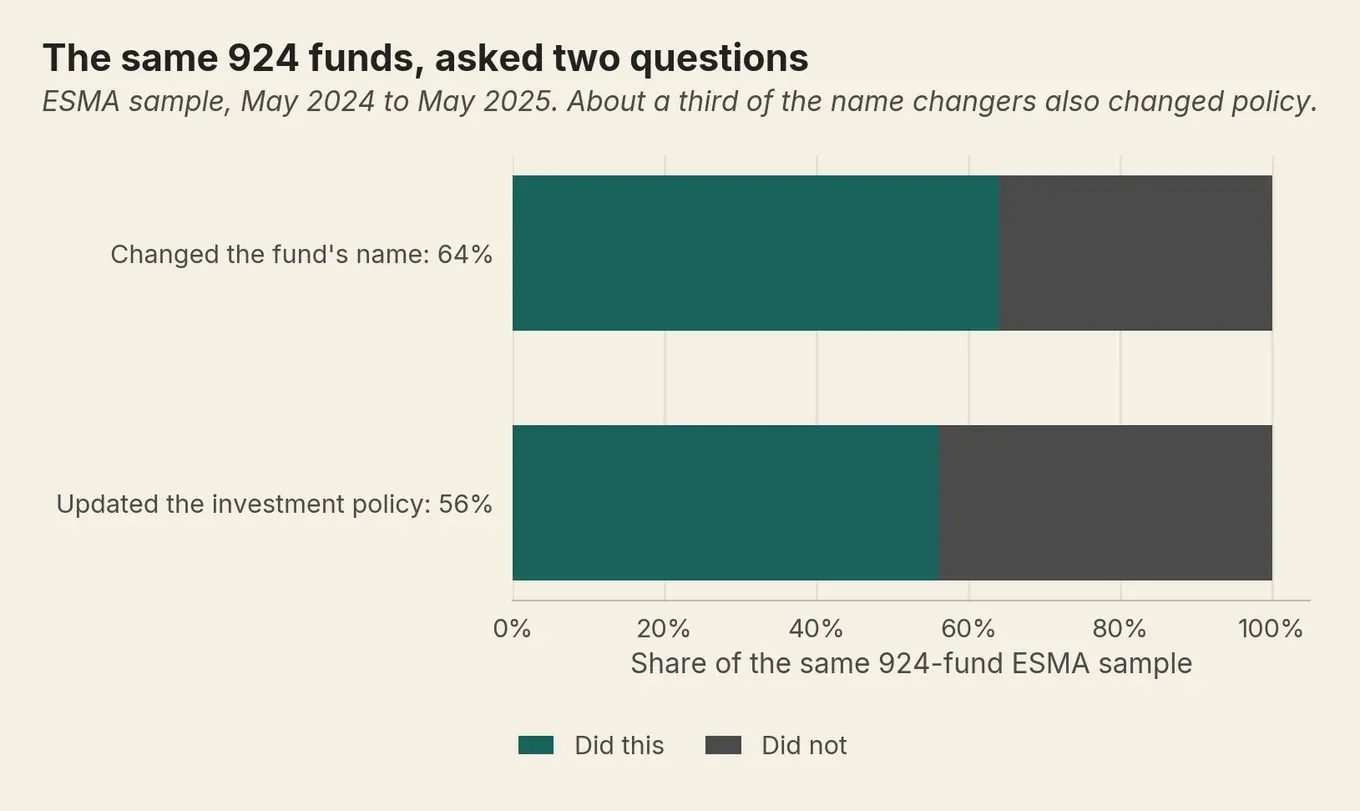
The interesting part sits inside the 600. Of the funds that changed name, 61% dropped every ESG term. A further 21% moved to a less demanding word, “Sustainable” becoming “ESG”, for instance. ESMA’s own conclusion: “This confirms that changing names was only one of the options available to fund managers to comply with the ESMA Guidelines.”
One further finding, reported flat. Across roughly 4,000 EU funds using ESG terms in their names, ESMA found that funds with higher fossil fuel exposures were more likely to drop ESG wording, an effect it says is particularly pronounced among fund managers headquartered in the US.
So: did the fund you hold change its name in the last two years? You probably didn’t notice. A renaming needs no consent from you, and arrives, if at all, as a shareholder notice you didn’t open. Worth checking, and not because a name change is sinister. Worth checking because it’s often the visible edge of a policy change, and the policy decides what you own.
Does ESG investing cost you returns?
The evidence disagrees with itself, and we’re not going to pretend otherwise. Three findings get quoted in this argument as though they answered one question. They don’t. Look at what each one compared, and the mess starts to make sense.
| Who measured | What was compared | Data period | What it found |
|---|---|---|---|
| ESMA (opens in new tab) | ESG against non-ESG UCITS funds | 2019 and 2020, regression to September 2021 | ESG retail equity funds excluding ETFs were cheaper and better performing: total costs of 1.5% against 1.8%, and gross performance of 3.3% against 0.8% in 2020 |
| ESMA (opens in new tab) | Article 9 against Article 8 funds | Calendar 2023 | Split by asset class. Article 9 equity funds sat higher on ongoing costs, Article 9 bond funds lower, and no significant effect overall |
| Berg, Kölbel and Rigobon (opens in new tab), Review of Finance, 2022 | Rating providers against each other | Not established | ESG ratings from different providers diverge substantially, mostly because the providers measure differently |
Four reasons those don’t add up to an answer. The periods differ, with the 2022 energy shock sitting between them. So do the comparisons: the first sets ESG against non-ESG, the second sets one article number against another, which is a different question in similar clothes.
Then there’s the make-up of the funds. ESG funds were less exposed to small companies and more tilted towards developed economies, and both of those lower costs on their own. That’s why ESMA ran the numbers again with those differences stripped out, and then conceded that “further research is thus needed” to explain the rest.
The third row explains the first two. If the underlying ratings are unstable, studies built on different rating sources reach different conclusions about the same companies.
Fund values can fall as well as rise, and none of those findings tells you what any fund will do next.
What can you know for certain about the cost?
No verdict on returns, then. What you can have instead is the part that gets measured and published in advance.
ESMA’s 2025 cost report (opens in new tab) ran the numbers six ways on 2023 fund data, comparing Article 9 and Article 6 funds against Article 8 funds. Watch the Article 6 result, because Article 6 is the closest thing in that data to “not an ESG fund”. In all six, the gap wasn’t big enough to call real. On ESMA’s 2023 figures, funds filing under neither Article 8 nor Article 9 can’t be told apart on ongoing cost from Article 8 funds, in any asset class.
A boring result, and a useful one. The ESG label by itself isn’t what makes a fund expensive. ESMA adds that on total expense ratio, rather than ongoing costs, the equity gaps were mostly not significant either.
What the same report does tie to a large cost gap is structure. ETFs and passive funds carry much lower ongoing costs than active funds in the same asset class. That gap dwarfs anything the article number explains. If you want the lever you can pull, it’s that one, and it has nothing to do with the three letters.
What can you check on the fund you hold?
Six things, in the order you can reach them, and none of it is a recommendation about what to buy or hold. It’s a reading exercise on a fund you own. Five of them take a minute. One of them does not.
| Where to look | What to find | What it tells you, and what it doesn’t |
|---|---|---|
| The key information document or factsheet, first page | The SFDR article number | Which disclosure regime the manager files under. Nothing about what the fund holds |
| The fund’s name | Which kind of word it uses. “ESG” and “SRI” both count as environmental terms | Whether the 80% threshold and a ban list apply. This binds harder than the article number does |
| The index name, then the index company’s methodology document | The sector coverage target and the exclusion list | The only figure that meaningfully separates two funds with the same article number |
| The pre-contractual annex | The binding elements of the strategy, and the stated minimum proportion | Where a promotion becomes a commitment. The 80% is measured against this |
| The principal adverse impacts statement, or its absence | Whether the firm publishes one, or publishes its reasons for not doing so | Absence here is disclosed information rather than an oversight. A firm may lawfully decline, and must then say so |
| The ongoing charges figure | The number, compared like for like | The one item on this list that’s certain, disclosed and directly comparable |
If you do only one of them, do the third. It’s the only one that turns “which of these two funds screens more” from an argument into a lookup.
That one is also the most annoying. The rulebook isn’t on the factsheet, isn’t on the fund page, and is rarely linked from either. You take the index name, go to the index company’s own site, and open a PDF running to 25 pages or more. The pre-contractual annex is buried much the same way.
Anyone who tells you this is a five-minute job hasn’t done it. It’s a twenty-minute job, once, per fund, and then you know.
What does the check look like, minute by minute?
Try it, on the fund you already hold.
The key information document probably says Article 8. That’s minute one, and it has settled nothing about the holdings, which is why the oil is still sitting there.
Minute two is the name. If it carries ESG, SRI or Sustainable, the 80% threshold and a ban list attach to that word, and the name binds harder than the number above it.
Minutes three to five: find the index name. One line of small type, usually near the word benchmark, and the only thing on the page pointing at the rulebook.
The other fifteen minutes are the PDF. Search it for coverage. Find 25% and the index targets keeping a quarter of each sector’s tradable market value. Find 50% and it targets half.
Then stop. You know something the factsheet never said, about a fund you already own.
One check that does take a minute. If a firm is selling you the fund or advising you about it, you can confirm it’s authorised through ESMA’s databases and registers (opens in new tab). It pulls together the EU-level lists of investment firms and fund managers, and links out to each country’s regulator. Worth doing before you hand anyone money, and free.
None of that is a Money Owl complaint about ESG investing. It’s a description of a gap, and the people who built the thing describe it the same way.
The three European Supervisory Authorities put it in writing in June 2024: “Despite SFDR being conceived by the co-legislators as a disclosure regulation, the two disclosure regimes set out in Article 8 and Article 9 of the SFDR have been used as sustainability labels by financial market participants and understood as labels by investors.” That same opinion (opens in new tab) records that the status had been used “in marketing material as ‘quality labels’ for sustainability”, posing greenwashing and mis-selling risks.
From the other side, EFAMA (opens in new tab), the fund industry’s own trade body, concedes it: “Although it was not the EU regulators’ intention for these Articles to be treated as product labels, the application of SFDR has, de facto, split the EU fund universe into three categories.”
Regulators say the label got misused. EFAMA agrees it happened. And the figure that decides how much a screen removes, 25% against 50%, sits in a document neither of them puts anywhere near your factsheet.
Your fund tracks an index. The index has a rulebook. Go and read one page of it this week, for the fund you already hold. You’ll find either a screen you’re happy with or a number that surprises you, and both of those beat the word printed on the front.
Frequently asked questions
What is ESG investing?
What do SFDR Article 6, 8 and 9 mean on a European fund factsheet?
Why does an ESG fund still hold oil companies?
What is the difference between ESG investing and sustainable investing?
Why did so many European funds drop ESG from their names?
Does ESG investing cost you returns?
How can you check what your ESG fund actually screens out?
Sources (19)
- EUR-Lex: Regulation (EU) 2019/2088 on sustainability-related disclosures in the financial services sector (SFDR), consolidated text
- EUR-Lex: Regulation (EU) 2024/3005 on the transparency and integrity of ESG rating activities
- EUR-Lex: Commission Delegated Regulation (EU) 2020/1818 on minimum standards for EU Climate Transition Benchmarks and EU Paris-aligned Benchmarks
- ESMA: ESG rating providers
- ESMA: Public Statement on publication or distribution of ESG ratings by third parties, ESMA84-1427279869-1396, 1 July 2026
- ESMA: Final Report, Guidelines on funds' names using ESG or sustainability-related terms
- ESMA: Questions and Answers on the Guidelines on funds' names using ESG or sustainability-related terms, ESMA_QA_2373, 13 December 2024
- ESMA TRV Risk Analysis: Impact of the ESMA Guidelines on the use of ESG or sustainability-related terms in fund names
- ESMA: Report on total costs of investing in UCITS and AIFs
- ESMA TRV Risk Analysis: The drivers of the costs and performance of ESG funds
- Joint ESAs Opinion on the assessment of the Sustainable Finance Disclosure Regulation (JC 2024 06)
- ESMA: Databases and registers
- European Commission: Commission proposes improvements to SFDR, COM(2025) 841 final (a proposal, not law in force)
- EUR-Lex: Proposal for a Regulation amending Regulation (EU) 2019/2088 (SFDR), COM(2025) 841 final, 20 November 2025 (a proposal, not law in force)
- MSCI: SRI Indexes Methodology, December 2025
- MSCI: Selection Indexes Methodology, December 2025 (formerly MSCI ESG Leaders)
- CFA Institute, the Global Sustainable Investment Alliance and the Principles for Responsible Investment: Definitions for Responsible Investment Approaches
- Berg, Kölbel and Rigobon: Aggregate Confusion, The Divergence of ESG Ratings, Review of Finance, 2022
- EFAMA, the European fund industry's own trade body: Market Insights Issue 21, The SFDR Fund Market
— That's the lot. It is now night.
Want more of this in your Google results?
Add Money Owl as a preferred source, and Google will show our finance pieces higher when you search for them.
By Jure Jaklič
Founder and editor of Money Owl. Data analyst by trade; personal finance learned first-hand across six European countries.
Recommended

Dividend investing in Europe: is it really passive income?
Pooled across 2018, 2019, 2021 and 2022, 70.6% of European once-a-year dividend payments arrived in April, May and June. What that does to a monthly budget, and what living off it really costs.

Should I wait to invest? Five reasons people give
We ran 107,454 windows of European tracker-fund history since 2008. Waiting won three times in ten. Five reasons Europeans give for holding off, cross-examined: three lose, two hold up.

Does market timing work? Seventeen European forecasts, marked.
Every year Europe's strategists publish a number for where the market ends up. As far as we can find, nobody checks. So we marked seventeen of them, and the typical miss is bigger than a typical year.